Pages

Sunday, January 5, 2014

Saturday Half Day!

Hola Amigos!

After almost a week of hard work, Saturday finally came! We all had big plans for our first half day of the trip, however a quick reflection and discussion came first. Reflecting on all of our experiences in Panama so far, we delved deeper into the social issues regarding the post revolution Panama and United States control of the Canal Zone. Many great points were made as we all gained further insight about this crucial topic.

After this morning of hard work, we all split up to head out and enjoy our day! Many of us traveled to the Gamboa Rainforest Resort to relax and explore the jungle. Gamboa Rainforest resort is located in Gamboa, which was once a Canal Zone township for canal workers. Traveling there was quite interesting, as we saw remnants of the old towns and housing that the Canal workers once used. Gamboa was initially populated by mostly "silver roll" workers, which is quite apparent in the very different layout and design than the old American military base that is now the city of knowledge.
We also got one last great look at the Miraflores locks in use while driving by. It was great to see another perspective of the locks we had spent time at the day before.
Gamboa itself is located on the Chagres river and can only be accessed by this one old single lane wooden bridge.  Although we did not experience it first hand, we heard that this site was where massive flooding had happened in late 2010 that caused the Panama Canal to close temporarily. Seeing the massive scale of Gatun Lake and the power of the Chagres river, one can only imagine the incredible forces of such a flood. 
Shown above is the incredible view of the Chagres seen at the Gamboa Rainforest Resort. Because Gamboa can only be reached by one road, there are sections of rainforest here that are considered to be some of the least disturbed in all of Panama. Its amazing to think that land just as wild as this was upturned to built the canal. 
After enjoying view of the rainforest canopy and exploring the nearby jungles, we hit the pool for some relaxation before heading back to the city. The proximity of untouched, beautiful rainforest to the city is incredible. Never before have we seen such a juxtaposition of terrain and layout.

From your daily bloggers,

Richard and Ted

Friday, January 3, 2014

Miraflores Locks

Hola amigos!

Finally, on Day 3, we got our first look at the Panama Canal. Specifically, the bus brought us to the Miraflores Locks, the first lock system on the Pacific Ocean side of the canal. After sorting out getting student tickets (student IDs had to be shown), we started out at the Miraflores Visitor Center.

The main control tower for the Miraflores Locks
A short video about the canal led right into the museum where four floors guided us through the timeline of  the canal, including information about the present day expansion project. From there, we went onto the observation deck and watched ships go through the locks: 


A full panorama of the Miraflores Locks
Since it was the morning, the ships traveled from the Pacific Ocean to the Atlantic  Ocean, which corresponds with left to right in the above panorama. There are two “steps” in the Miraflores Locks, raising the ships a total distance of approximately fifty eight feet. The ship enters the lock, guided by locomotives to prevent the ship from hitting the lock’s sides, and the massive gates close. Filling the lock takes around ten minutes as the water moves from Lake Miraflores to the lock by gravity. Upon filling, the gates on the other side of the lock open and the boat moves on to the next lock or to Lake Miraflores. In the distance are the Pedro Miguel Lock and the Centennial Bridge. The construction behind the white main control building is the expansion project, but more about that will come on Monday. 

Group photo on the observation deck
Post-lunch activities included a discussion focusing on the Panama Revolution in 1903 and a group persuasive essay. Potentially our most controversial discussion so far, we debated over the ethics behind the major players in the revolution and whether the United States could have gained control of the canal zone without “stepping on a few toes” in the process. Our group essay had each team pose as editorial newspapers, each team from a different country, writing their reaction to the Revolution. The different countries were the United States, Panama, Great Britain, and Columbia.

All in all, it was a very gratifying day. The Panama Canal, which had been hyped up by the TAs and Professor Berger, met and even exceeded everyone’s expectations. The size of the locks caught many people off guard and proved what an engineering feat this really is. Upon seeing the actual entity that drives our course, we are extremely excited to see how future days can live up to today. It’s hard to imagine they will now, but I’m sure we will be pleasantly surprised!
Your Day Three Bloggers,

Kyle, William, and John

Thursday, January 2, 2014

A Day Around Town


Hola amigos!

      Day 2 began when the church bells across the street rang loud and clear at 6am sharp.  Luckily we didn't have to get up just then, so we dozed until the bells tolled the next hour, reawakening us at 7am and reminding us of the day to come.  Day 2 really began with a trip to Panama Viejo (Old Panama) where we saw the ruins of the first Spanish settlement in Panama.  Founded circa 1519, it was the first permanent European settlement on the Pacific Ocean.  Spanish influence was apparent in the organized layout of the buildings and roads, as well as the construction of a covenant and nunnery on the site.  Central to the site was a lookout tower that provided views of the settlement from one side and the Pacific Ocean from another.  The view from the top was an interesting juxtaposition of the thriving metropolis of modern-day Panama City to the ancient ruins of the first Spanish settlement.  The ruins of Panama Viejo are what remains after the settlement was attacked by pirates in 1671.

Inside the convent at Panama Viejo.  A large tree grows in the center of the ruins.
From left to right: Emily, Kelly, Eleanor, Lara
Hi Graeme!
At the top of the tower.  From left to right: Kelly, Elyse, Eleanor,  Emily, Lara.
The view of modern-day Panama City from the tower.
      From Panama Viejo, we headed to Casco Viejo (Spanish for "Old Town"), which is the historic district of Panama City.  The city of Casco Viejo was built in 1673 by the Spanish after the destruction of Panama Viejo.  For lunch, our class split up and we had the chance to wander around the city.  Of particular note in the city were the beautiful, intricate ironwork on the balconies and the colorful facades of the buildings.  The narrow streets and the central square were an indication of the age and Spanish cultural influences of the city.  For lunch, we ate at a small restaurant called Diablicos.  Unfortunately, we were told by the waiter that several of the items on the menu were unavailable because the restaurant did not have electricity until 3 pm, which, to our surprise, turned out to be a regular daily occurrence! 

Colorful facades of Casco Viejo.
From left to right: Kelly (in back), Lauren (in front), Lara, Elyse, Eleanor.
The narrow streets of Casco Viejo.
      After lunch, our class reconvened in the central square and visited El Museo del Canal Interoceanico de Panama (The Panama Interoceanic Canal Museum).  The museum focused on the chronological history of the Canal, beginning with the discovery of the Pacific Ocean by the Spanish conquistador Vasco Nunez de Balboa (after whom the local $1 coin is named - the Balboa).  Our favorite part of the museum was learning about Martyrs' Day in 1964 (a national holiday celebrated on January 9th).  This incident eventually influenced the return of full control of the Canal to the Panamanians, which up until then had been occupied and operated by the United States.   An interesting fact is that 2014 marks the 50th anniversary of Martyr's Day as well as the centennial anniversary of the grand opening of the canal.  We picked a good year to visit!

     On our way back to the bus, we discovered a local ice cream shop that offered a multitude of unusual flavors.  It seemed that ginger was the unanimous favorite.  As the locals would say, "muy delicioso!"

Signed, your day 2 bloggers,
EL
(Eleanor Love and Emily Leivy)

Wednesday, January 1, 2014

Parque Natural Metropolitano de Panamá


Parque Natural Metropolitano de Panamá - Day 1


Hello friends!
Because today is the first day of the New Year, many places were closed so we had to alter the schedule a little bit. Even though this was an impromptu outing, it setup an appropriate context to learning about the challenges of building a canal in Panama.
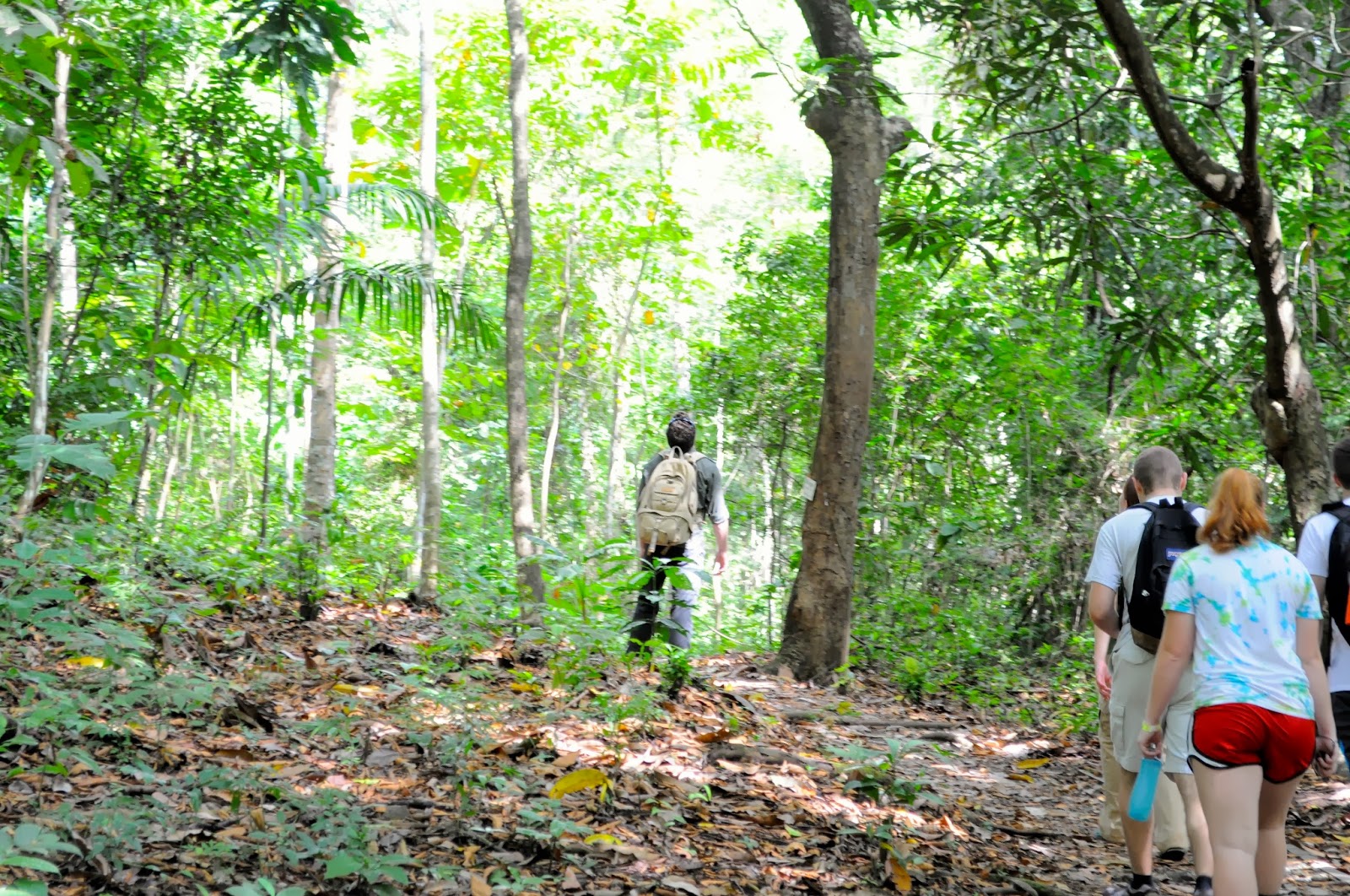
After eating breakfast at the hotel, the 20 of us students split in half, and grabbed a taxi van to the Parque Natural Metropolitano de Panamá (Metropolitan Natural Park), which was a 15-minute drive from our hotel. This is the only wildlife refuge in the city and that’s why it has gained the title as “the lung of Panama City”. We arduously sprayed ourselves with bug spray and ventured into the humid jungle… literally. Even though there was a stone walkway, it felt as if the jungle could reach out and touch you. For example, the animals we saw were monkeys, butterflies, caterpillars, turtles, and leaf cutter ants. Below is a picture of an ant working hard…


The terrain was and still is impenetrable. There are trees with spikes for example.


One can hardly imagine how the French and Spanish crossed Panama without modern technology. That’s one reason why the canal is so spectacular, simply in its location. Our TA Trevor was certainly impressed:


The state of the jungle also demonstrates the extent at which people were willing to go for trade. Regardless, it always maintains a captivating beauty


 as well as entertaining flora and fauna (refer to the fallen fluffy tree flower and caterpillar bark carpet).


After the jungle, we scrambled to find some lunch because we were starving, hot, and thirsty. Some of us went to a locally recommended cafeteria called Nikos. It was delicious and cost me $4.75. I had 2 cups of rice and black beans, lentils, steamed vegetables, and arroz con leche (rice with milk). The quality of food here is delicious and the price is also appealing for us college students.
After lunch, we gathered at the pool deck, under the hot sun. Remember, we’re here for academics too! We discussed the jungle and motivations of why the Spaniards showed such an interest here. Then, we went on an adventurous scavenger hunt, where we were assigned to find a bear (in Panama??), cranes (which there are a plethora of), Christmas trees, and a Panama hat – just to name a few. I’m sure that we looked like super tourists, which is not always a bad thing, but I’m sure that we entertained the locals and we got to know the city better.


After working up a huge appetite, we embarked on an eating escapade. Though we don’t remember the title of the restaurant, we do know many important facts such that you should go here if you venture to Panama City. Here are the basics
1)     Serving a party of 21 is not an easy task… but it’s doable
2)     You pronounce double “L”’s on the menu as a “y” such as rollo = royo
3)     Watermelon juice smells like summer
4)     It is possible to serve Lebanese, Japanese, and Panamanian all on one menu and all very well
5)     Professor Berger knows insider tips on eating edamame, and always will order ceviche when he comes here.


Now, we are sitting here letting the food settle and downloading the reading for tomorrow. As the first day of 2014 comes to a close, in the famous words of Bunua Varilla (a French engineer of the canal), “let us think only of the fight of tomorrow and of victory”. 
Signed, your day 1 bloggers, 
Elyse McMillen and Lara Sisman

Happy New Year


Happy New Year and Welcome to Panama!


Dear friends and family,

Everyone safely arrived here at the hotel. The airport was beautiful and the taxi cabs were varying in their level of excitement. 10 of us for example, piled into a taxi van whose driver drove us rather "legally". But then another group of us experienced the true Panamanian taxi adventure. Thus for some of us (Elyse, John, and Chase), the taxi ride was more dangerous than others. McMillen quotes, "You didn't even use a blinker... you swerved in and out of traffic, forcing even other taxi drivers to careen out of your way. I didn't think I would make it to the New Year", she says laughing and sighing. We convened at 11 p.m. on the relaxing pool deck while a loud, New Year’s Salsa party commenced next door. Then, there was a huge fireworks display off of a parking garage and we counted down 2014 in the local manner: "Cinco, Cuatro, Tres, Dos, UNO!".
It was memorable and fun...and loud! We were all really tired but excited to finally experience the culture, food, and history of the area. 
Signed, your day 0 bloggers,
Lara Sisman and Elyse McMillen